Thursday, February 17, 2011

Kitchen drama


Finding my third internship was not easy. For starters, I am much pickier than I was four months ago when I was looking for my first internship; at that time I just looked at a list of top Marseille restaurants from a NY Times article and went to the one which appealed to me most; I was hired on the spot. For my second stint, I visited one restaurant where I felt the chef welcomed me hesitatingly before suggesting the Sofitel, which is where I ended up. Having worked at two fine-dining (or “restaurants gastronomiques” as they call them here), with large kitchen crews, I thought it would be nice to try a smaller restaurant, to work more closely with the chef and get a more intimate feel.
A classmate had been interning at a medium-sized restaurant not too far from my house, and when she told me she was too tired to work extra hours one Saturday morning I told her I would fill in for her (her chef had seen me and asked about me a few days before), which I did. Not to enter into too much detail, but I realized that I had probably been spoiled by my first two experiences with the beautiful, spotless kitchens and all the top of the line toys, and I knew from the moment I stepped in that I could not work there.
Next I ventured into another restaurant in my neighborhood and told them I was looking for an internship in a small kitchen. The chef offered me to try out one lunch service which I did – that didn’t work out either (cf. my entry on the smoking chef).
I also tried a small restaurant with one Michelin star and left my contact info with them; they never called me back, which I take as not an encouraging sign, so I did not really follow up.
Then I contacted two highly-rated restaurants along the coastline, though that implied that I would be back in the fine-dining/large crew mode, but both were closed for one week in February in the middle of my internship! I really felt like I was running out of luck.
Finally I called a restaurant which also has one Michelin star near my house… spoke to the chef a few minutes after I was taken. I guess it was meant to be. The reason I didn’t want to work at this place to begin with is that I heard a few negative things from several people about chaos reigning in the kitchen because there are two chefs instead of one…
My first day was bitter-sweet; sweet because I like the food I saw and the way the kitchen was laid out; all in one room (except for the pastry and fish shop), so that everyone gets a feel of what is going on. Also the view from the kitchen is amazing, with windows all along and the Mediterranean right below. The bitter part came as a result of the drama I was indirectly caught in on my first day.
Though I had mentioned to the chef who interviewed me that I was interested in working the fish station (the request was bold, but my cooking instructor had suggested I mention it, since did not want to spend a week in pastry and garde-manger again), the fish guy was not in and I was paired with the “garnitures” guy. His job is to prepare all the sides for the dishes, which requires constant coordination and perfect timing with the guys on the hot line. So Garnitures Guy, as I will call him, seemed really stressed out and unsatisfied with his job. In a few minutes he had told me all about himself, that his wife was Korean, that he had three kids and his eldest was fluent in four languages, that he had worked with Ducasse in Paris, etc. This guy was quite a piece of work. As the morning went on I saw that he was getting more and more stressed (he couldn’t even get family meal out on time), exhausted and overwhelmed and generally unhappy. Meanwhile I was just doing what I was told, namely peeling and chopping vegetables. At one point I was asked to prepare the salsifis (oyster plants) which are a bit tricky to handle, so the chef came and showed me what to do. A few minutes later, GG came to see me (I was stationed at the empty fish post at this time, a little bit removed from the main kitchen) and showed me his way to do it, which was slightly different from the chef’s. Of course this put me in a very embarrassing situation, and I just continued doing what I thought was the best way, half-way between the two instructions. A few minutes later I hear the chef shout my name, so I go to see him and he asks me: “Did you understand my instructions?” I hesistantly reply in the positive… “So why did GG have to explain it to you again?” I knew I was not in a good place at that point. I sort of mumble something and quickly went back to what I was doing. I realized that he was not angry towards me but towards GG. Apparently they had been experiencing some tension lately. After lunch everyone was cleaning up but GG was not in the kitchen. He was talking with the chef. At one point I heard him shout “What am I gonna tell my wife?” That was on Valentine’s Day.
The following day GG was no longer there – of course I didn’t dare ask if he had been fired. I checked the work schedule and he was indeed on leave that day and the following day. I ended up with someone else, still at the same station. Everything was fine until lunch time. I was chopping away by the window, with my back to the stove, thinking how distractingly beautiful the view was, when I suddenly felt like I was about to pass out. I had felt a bit under the weather for the past two days but could not afford not to show up on my first day… nor my second. Of course feeling a bit under the weather and going to work and sitting in front of your computer (which is what I did at my former job) is not the same as feeling that way and going to a kitchen where you are standing all day, cutting and lifting heavy containers and alternating between the cold of the walk-in refrigerator and the violent heat of the hot line. So I started feeling feverish and nauseated and I rushed to the basement to cool off in the walk-in. I did this twice before I started to feel better, at this point I didn’t care if they wondered where I was off to in the middle of the service. I don’t know how I managed the rest of the day but after work I went straight to the doctor and sure enough I had an angine or a throat infection. She prescribed me some antibiotics and told me to stay home for two days. Tomorrow I’ll be back in the kitchen, insh’allah.

Sunday, February 6, 2011

The Epic Battle of Bonneveine – 4 February 2011


Last week was my week of exams which culminated in the four-hour practical test on Friday morning. We had to be at the other side of town at 7:30 am with all our cooking gear. The event was held at the Lycee Hotelier which is a high school where kids train for a career in the hotel and restaurant business.

There were about forty of us taking the exam that day, with a majority of adults. We were given numbers to identify us and were separated into two large kitchens where each of us had a full post with our own oven, burners, pots and pans and sink. It was a change from the small kitchen from my school, where we work in groups of five to seven, the other group rotating on theory. I was surrounded by people from another school I didn’t know.

Throughout the week I had been reviewing the exams from the past years; for the practical, you are asked to produce two dishes (plus side dishes), a first course and a main course or a main and a dessert. I noticed that there had been a lot of tarts (there are no pies in French classical cuisine with the exception of the Pithiviers which is a puff pastry pie filled with almond cream and only served during the Epiphany or Three King’s Day in January) so I practiced my crust all week. The two courses that made me nervous was the rabbit, since we had not seen it in class, and also trussing a chicken, which I had no idea of how to do (I tried to do it on my own with the help of the manual but it was a catastrophe).

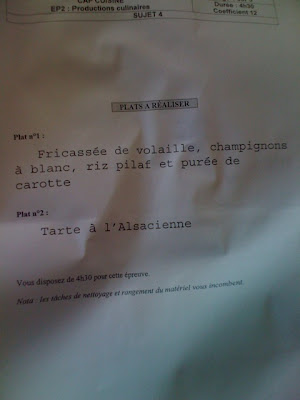
Sure enough, when I saw the instructions laid out on the table alongside my identification number, there was a tart for dessert and a chicken dish for the main course. I immediately gained confidence since these were dishes I was familiar with. We were required to produce the following: Fricassee de volaille, champignons a blanc, riz pilaf et flan de carotte (Chicken fricassee with mushrooms, pilaf rice and carotte flan) et Tarte Alsacienne ( an apple tart with a flan filling). Being in an exam situation surrounded by chefs walking around observing you and taking notes is a nerve-racking experience. I did my best to keep my cool as I had heard of horror stories of candidates unable to perform because of the stress of the situation. I had to remind myself that this exam was normally taken at the end of a comprehensive two-year course, and that I had only been through two months of class and two months of interning in a professional kitchen. Still, reading over the recipes, my mind couldn’t help but racing with all the blood rushing to it, organizing the steps of my production, which I had to serve to the jury at the required temperature in time for lunch.

The crust

I knew without hesitating that the first thing I wanted to get done was the pie crust. Crusts have to rest to get firm and in some cases need to rest again once they are placed in the pan (I don’t know these technical terms in English, will need to look them up at some point). In certain cases, they also need to be baked empty and cooled before being filled. So I proceeded with my crust. Though I was confident overall, the pressure of the situation visibly clouded my senses, making me hesitate over things I normally wouldn’t. For example, it took me a while to decide whether to make the crust in a bowl or directly on the marble. I mentally performed a rapid scan of all the crusts made in class and in the restaurants and also the techniques described in the manual, which is our Bible. I opted for the bowl, a bit annoyed of wasting precious time on such a minute decision. Though the proctors advised us to focus on our work and not pay attention to what the others were doing, I couldn’t help but glancing around. That’s when I saw that everyone was chopping up their chicken! I was the only one doing my crust. This made me a bit nervous and undermined my self-confidence, so I read the two recipes over again. Yes, there was a chicken stock to make, but the clear chicken stock required in the dish only needed to cook for one hour (cooking times were not indicated in the exam recipes, we had to memorize them), this I remembered clearly as it struck me as rather short. So I continued what I was doing, a little destabilized. Like I said, I had done crust after crust over the past few weeks since this is one basic notion that comes up again and again and that we should know how to do by heart and blindfolded. As I started crumbling the butter into the flour with my finger tips, I realized how tense I was… almost to the point of shaking. It was the most tedious crust I have ever made, with each pressure of the still hard butter between my thumb and the rest of my fingers demanding seemingly the strength from my entire body. And this only a few minutes after the start of the exam! After a tremendous amount of effort, my crust came together. What a relief it was to put it away and start my chicken.

The stock

Stock is one of the most basic elements in the French kitchen (alongside pie crust!) and I managed to completely mess it up. First when I started carving the chicken, I couldn’t find the little fleshy part at the top of the leg (le sot-l’y-laisse) which is presumably one of the tastiest parts of the bird and which needs to be carefully carved away from the bone and attached to the leg. So here I was panicking, feeling the chicken up and down, not finding the damn thing, which is the size of a quarter! Till now I am still not sure I was able to find it and cut it correctly. Nevertheless I managed to cut off the legs and breast quite nicely, but it all went downwards after that. For some reason, I knew I needed to chop up the carcass (it was indicated in the recipe!) but I didn’t. I plopped it in the vat after only cutting off the wings. Then, I proceeded to chop the onion and the carrot. One of the inspectors was looking at me and I knew I had done something wrong (there is nothing worse than chopping something while someone with a notepad is staring at you and taking down notes; there were about half a dozen inspectors going around the kitchen observing us). That’s when I realized –the onion goes in whole with the clove stuck in it. I also forgot to add the leeks… in other words, my stock was not according to the book. I wonder how many points I lost for that.
Funny how when you’re in a stressful situation you can read a sheet of paper over and over and not take anything in. I didn’t know what to do next… should I start the flan or the rice? They both need to come out hot and it was still very early… I knew at least that I would do the chicken and the sauce last minute. So I continued with my tart.

The tart

All those tarts made at home really paid off because I rolled out my two shells (we had two to make in different pans) turned out beautifully. I was the first to pop them in the ovens and have them done, only to be told by my neighbor that they were meant to be eaten warm… I stand by my decision to serve them room temp to the jury and hope they agree.

The rice

The first time we made what they call rice pilaf in class I was appalled by the amount of butter that went in it. So I knew, I would put a ton of butter in this rice, as that is how the Gods of French Gastronomy like it. I kept thinking to myself, I have never, nor will I ever make rice like this at home! I followed the recipe to the letter, cutting out a wax paper circle to go over it, making a bouquet garni of leeks, thyme, and laurel to pop in it, and finishing it in the oven. It had to be all dente, salty and full of butter, nothing to do with rice in the Philippines…

The carrot flan

We made these little timbales of molded vegetable puree, eggs and milk in class and I thought they were the sorriest side dishes ever, bland and soft like hospital food. But here they were in my exam, and I knew how to do them. What I completely blanked out on, was how to kick off my bain-marie… I wanted to boil the water before pouring into the cooking dish and into the oven, but one of the inspectors was staring at me and made me so nervous that I just popped the damn thing in the oven with cold water. Sure enough, it took the longest time to cook, and my issues with my oven temperature did nothing to help.

The mushrooms

I am a big fan of one-pot cooking at home (everything cooks together, like in a curry or a chili con carne), but most of the garnishes in the recipes we do in class are cooked separately, which means if you have three different garnishes in your stew (say carrots, radishes and pearl onions), you need four different pots. Not the most energy efficient if you ask me, but that’s how it’s done. As this was a white dish, the mushrooms had to be white. So I scalloped them as per the recipe (cut in quarters diagonally) and then cooked them with lemon and butter. The result was appalling; they cooked unevenly and ended up browning in spite of the lemon. In French cuisine sauce classification is a big deal; it almost reminds me of United Nations Human Resources rules in its rigidity and detail. Let’s just say that in my case, my white sauce was very, very tanned.

The oven

Another thing I never did at home was to finish cooking my food in the oven. That’s how stuff is done here – whether it be duck breast, rice, chicken parts, what have you, it’s finished off in the oven. Thank god that in only four months of intensive cooking, my sensitivity to heat has greatly diminished. One hour into the exam I was overheating but that was normal. But what happened next really surprised me and it was both not so pleasant and very pleasant at the same time.

By the time my carrot flan and rice were in my oven (the tarts were in a separate pastry oven at the far end of the kitchen) I noticed that it didn’t feel hot (the oven, that is!). Normally when you open a professional oven you get a gush of hot air in your face which is unmistakable. I asked one of the proctors to check it and sure enough it was not heating well. He had to fiddle with it several times to finally end up setting it on full blast to get a semblance of a result. In the meantime, I had to take three of my dishes, the rice, the flans in the water bath and the chicken with the stock, in and out of the damn thing time and again to check them for doneness but most of all rearrange to fit everything inside. Now the oven was not enough to get things going but it was certainly hot enough so that all the pots inside were burning hot. After checking my chicken for the Nth time, meaning to say placing the burning pot on top of the stove, then back in the oven, then back on top, my arms were literally shaking. At one point I was so overheated, exhausted and exasperated that I took out the pot without carefully wrapping the handles with a rag… I immediately felt a searing sensation on my hands but I knew if I wavered the whole thing would end up on the floor, so with my arms shaking and my hand burning I managed to place the burning pot on top of the stove.

Now this act which happened in about a split second seems completely meaningless but meant a great deal to me. To put things into context, six months ago I had no idea I would be doing this and even less taking this national exam. For me cooking, at least professionally, was my mother’s territory. I loved cooking at home and entertaining but never thought of doing it as a job. When I visited my mom’s kitchen, there were three things I feared: the walk-in refrigerator, since I don’t like the cold and had nightmares of getting locked in there for hours, nobody knowing where I was, the deep-fryer, and the oven. I coiled from contact with extreme temperatures. And now, lo and behold, I could lift a burning pot out of the oven filled with chicken and stock and just tell myself, hey this is really hot. I feel like I’ve come a long way in the kitchen.

The girl next to me (who had destabilized me by saying that the tart had to be served warm) burned her arm and one of the proctors was attending to her with some white cream. As I ran cold water over my burning fingertips I realized that I needed them to cook and so could not ask for first aid myself. Funny how mind can overcome physical pain in certain circumstances. I still had a lot to do and so could not focus on the pain in my hand.

In the end I was the second person to serve my dishes at the correct time. My white sauce was brown, my tart was room temperature, my stock was leek and clove free… but overall I think I did okay. Two days later my body is still sore from the event, as if I had run a marathon. My hand doesn’t hurt so much so it must not have been such a bad burn after all. But in the midst of Friday’s chaos, I was able to pause and tell myself that there was no other place in the world I would have rather been, and no other thing I would have rather done at the time. With my sore hand and my greasy rice, I couldn’t help indulge in a moment of unadulterated cheesiness and smile, out of pure love for it all.

Wednesday, January 26, 2011

Like a firefighter

Of course I would have to pick the week before my exams to try out a new kitchen for an internship and volunteer to accompany Sara's class on a field trip.

There are many things about the restaurant I just came from that would make it an ideal place for me to work in: it's near my house, it's small (there is only the chef in the kitchen and his partner in the dining room), it's super clean, the food is decent, the interior is minimalist. However, of all the little reasons I would not work there (they put cream in their risotto, the dessert I had was underwhelming), the main one would be that the chef smokes "like a firefighter" as they say here (comme un pompier). All morning, it was cigarette after cigarette. Granted, there were not a lot of clients today so he had more time to smoke that usual. But when I saw the lit cig a few inches behind my back as I was applying myself with a pail of jerusalem artichokes (yes, again), I knew I could not work there. I guess I am getting picky, or perhaps I was spoiled with my two first experiences where the kitchens were spotless and everything was by the book. So yes, I can be "psychorigide" in the kitchen, which vaguely translates as ... anal (in the Freudian sense of course). I just believe that if there is a proper way to conduct a particular operation, then why not do just that and augment your chances for the best possible result. I realize that this is not brain surgery and that no one will die if a vegetable is peeled over a chopping board and not a poubelle de table (table trash bin) but I think that there are a few good habits I have picked up and don't want to compromise.

Wednesday, January 12, 2011

Warning: do not read further if you are vegetarian!

I asked around and few of the others in my class if they were at the hotline. In most of the restaurants, the chef or the sous chef are the only ones who supervise the cooking of the meat, not the lowly interns (usually right below the apprentices and above the dishwashers in the kitchen hierarchy). So I guess I should be honored that the Chef last week granted my wish to spend my last day at the grill. He sent me to the meat, and not the fish station.
Working at the meat station implies handling raw flesh. After lunch was over, I was given the task of preparing the pigeons that I had just seen being cooked and served. I was enthusiastic at the idea of doing something new, and thought I was really tough, working the meat station with my own knives. I had no idea what I was in for. I was given a huge box which contained over a dozen birds with their feathered heads still on, their sharp beaks and eyes tightly shut. This must be some kind of sign of freshness, to keep the heads on, as the Chef had once paraded a headed chicken wrapped like a papoose around the kitchen like a proud father with a newborn baby. The cook who was showing me what I had to do took a bird, stretched it a bit, grabbed some shears and cut off three of its toes, leaving the middle one intact. This one he shortened with a swift snap. Then with a cleaver, he clipped the wings, and the tail. Finally he pulled the head, performed a precise incision along the neck, lifted the skin covered with pristine white feathers off and gently tugged on the skinned neck, cut the skin, and then brought his cleaver down over the neck, beheading the animal.
So I tell myself (the cook has already left at this point, without noticing my bewildered look), “well, you’re a cook, you like challenges, you can do this, it’s not as bad as that box of furry rabbits at the other restaurant.” I grabbed a pigeon and started pulling. The sight of the intact head was appalling but so were the feet with their granular surface and the hooked nails. I cut the toes off, then the wings, then the ass. I made a cut through the skin of the next, through the feathers, and loosened the skin. I cut the skin, then the neck. At that moment, the most ridiculous and disgusting thing happened: grains of corn started falling on the chopping board. Whole, dried, bright yellow kernels and some wheat too. I don’t know why, but I found that more revolting than anything else, almost obscene in an indescribable way. Almost all the birds had them, their not yet digested food tumbling out of their dead bodies.

Back to school

I was happy to go back to class after my three-week stint at the Sofitel’s restaurant. What made it even better was the fact that we were in the kitchen for the full day, instead of half-day as usual (the other half of the day is usually devoted to theory, eg. categories of sauces). Everyone was ebullient with questions and ready to share their experience of the past month. Our teacher expressed her disappointment at the number of absences; a portion of the interns happened to get sick between Christmas and New Year, at the dismay of their respective chefs.
Yesterday the class successfully prepared a hundred-guest new year luncheon for the staff of the school and the region’s administrative offices (whose funds we are enjoying). Having confirmed my preference for savory over sweet both at home and at work, I was able to do the stuffing for the cherry tomatoes (goat cheese, fresh cheese called faisselle, olives and chives), flip a couple dozen crepes, to be filled with caramelized pineapple and secured with orange zest ribbons en aumoniere, and finally, prepare and cook the guinea fowl in orange sauce. Being by the fire, facing the heat, is what I like best.
All the guests were extremely surprised and pleased by our performance. We had had puff pastry with different savory fillings for appetizers, then the stuffed cherry tomatoes, tuna-zuchini roll-ups and foie gras with onion chutney for first course. Next came the guinea fowl in orange glaze with orange supremes (everthing was bite-sized) and white fish with balsamic cream and alfalfa sprouts and spinach leaves. There were slates covered in a variety of fine cheeses… and to end, the Galette des Rois or Pithiviers (puff pastry filled with almond cream, typically served during Epiphany or Three Kings’ Day), chocolate cake with crème anglaise (vanilla cream), and the aumonieres with their caramel sauce. At the end of the day I felt a bit sick from all the food. I have never in my life had so much foie gras or galette. On the other hand, I was happy with our team work and felt ready to take on more!

Thursday, January 6, 2011

Kitchen characters II

This week I met another kid, at the hotel’s café, where the chef sent me to help out. The café is in the lobby and has its own kitchen, except without an oven. It has a full view of the old port with its magnificent forts (which give their name to the hotel’s main restaurant). Kevin was alone when I found him – or rather when he found me waiting for him - and looked very surprised to see me; as a matter of fact he immediately called the chef who confirmed to him that I would spend the day there. I joked that I was sent to keep an eye on him… It turned that we had a very good day together, though I did more mise-en-place (that is, preparing the ingredients for the dishes) than actual cooking. I don’t mind – actually I relish any job I am given, since I consider any task a learning experience. I often think of Helene Darroze, a top chef in Paris and chef to my former sous-chef – whom Alain Ducasse sent to “sort salad” for six months in Monaco, though she comes from a lineage of famous French chefs.
Kevin is one year older than Petit Jean, and has worked in the kitchen since he was sixteen. He told me about his work at the fish station in Avignon and how much he loved it. When I asked him why he left, he told me the hours were too long and he and his girlfriend wanted a change of scenery. So while he was hired by the Trois Forts’ chef, he was sent to the Carré. He missed the hot line and the fish. Apparently he had a similar disappointing experience in Lausanne, where he applied at the hotel Beau Rivage where Anne-Sophie Pic, the most famous female French chef, held court. He was so excited to be working with her, but when he reported to duty he was sent to the café, and had the frustrating experience of making salads and club sandwiches while watching the chef work her magic on the other side of the glass in the main kitchen. He told me he would have stayed on had he found housing.I think these kids would do great in the States... they are so young but already so knowledgeable about classical French cuisine and techniques. I really need to catch up!

Tuesday, January 4, 2011

Kitchen characters

Working in the kitchen, you meet a whole different type of profile than at the UN, but somehow, people’s stories and lives are just as interesting. As previously mentioned, the average age encoutnered is roughly twenty years old, without counting the chef of course (thank god they are older than me, at least so far). As such, I have met two very interesting eighteen year olds, whose stories, for their young age, really captivated me. First was this little kid in the garde-manger, and when I mean little, he is shorter than me and they actually nickname him “petit” Jean (not his real name). I met him while I was still working in the pastry station, which is adjacent to his station. He flattered me by saying that he was convinced I was his age (yeah right), and then made me wonder about his life when he said he spent Christmas with his cat eating McDonald’s take-out. I thought it that was strange, for a kid his age, from here, to be spending the holidays like that. I got to know him a bit more during my second week which we shared at the same station. When he came in late last Monday the chef de partie (boss of the garde-manger) was worried because he was not picking up his cell phone. Later that day he showed up with bandages and scratches on his face; he was in a car accident, his friend was driving him home when a car collided with them head on; the driver was drunk and was driving in the wrong lane without his headlights; Jean’s friend did not survive the crash. Jean told me it was the fourteenth person he had lost over a period of two years. I could not imagine how at eighteen years old you could lose so many people, except of course in a war or disaster situation. I wanted to know more but of course left him alone.
It turned out that Petit Jean was my neighbor. He lived alone with his cat in an apartment close to the hotel where he had been working for over a year as an apprentice. When he first started he was working the hot line, the meat station to be more precise. One day he was cooking next to the sous-chef and there was a huge vat of hot oil on the stove for potatoes. As the kitchen got busier, the oil started to smoke, and so petit Jean picked it up to carry it away somewhere out of danger. As he was going through a doorway and shouted “chaud devant” which is what you do to warn someone to get out of your way in the kitchen, another cook didn’t hear and showed up in front of him. Petit Jean froze, and the burning oil made one slow wave which covered the pot’s handles and his hands which were holding them. As he let go of the pot in shock, the skin from his hands stuck onto the handles. He had to be treated for four months for burns at the hospital, and cannot tolerate being near heat anymore…